Monday, April 3, 2017

Post #8, House of Representatives Hall & Gallery

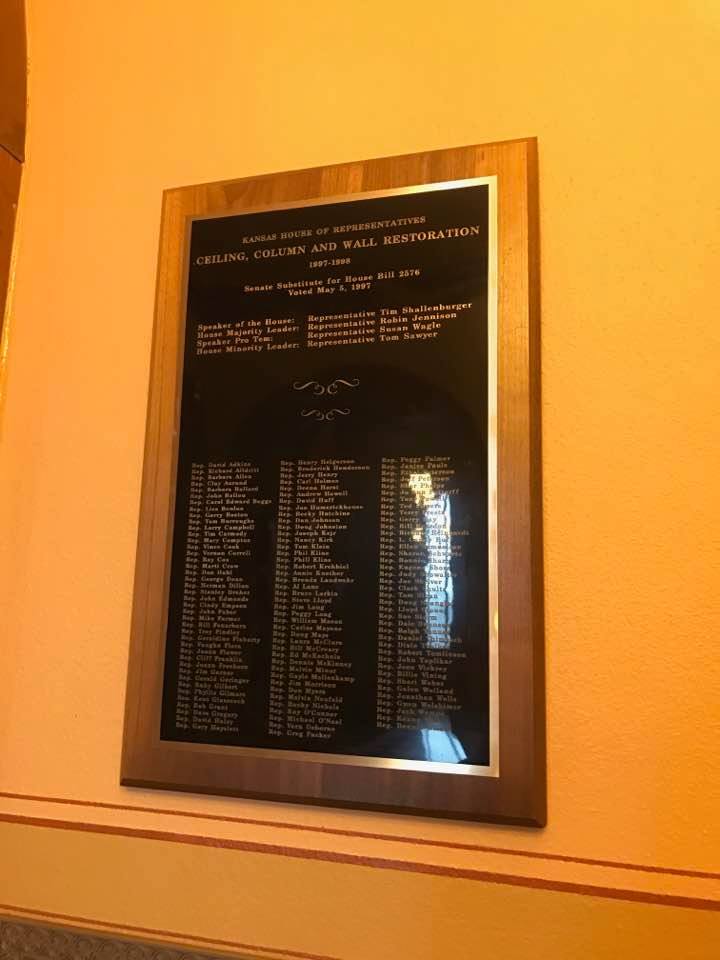
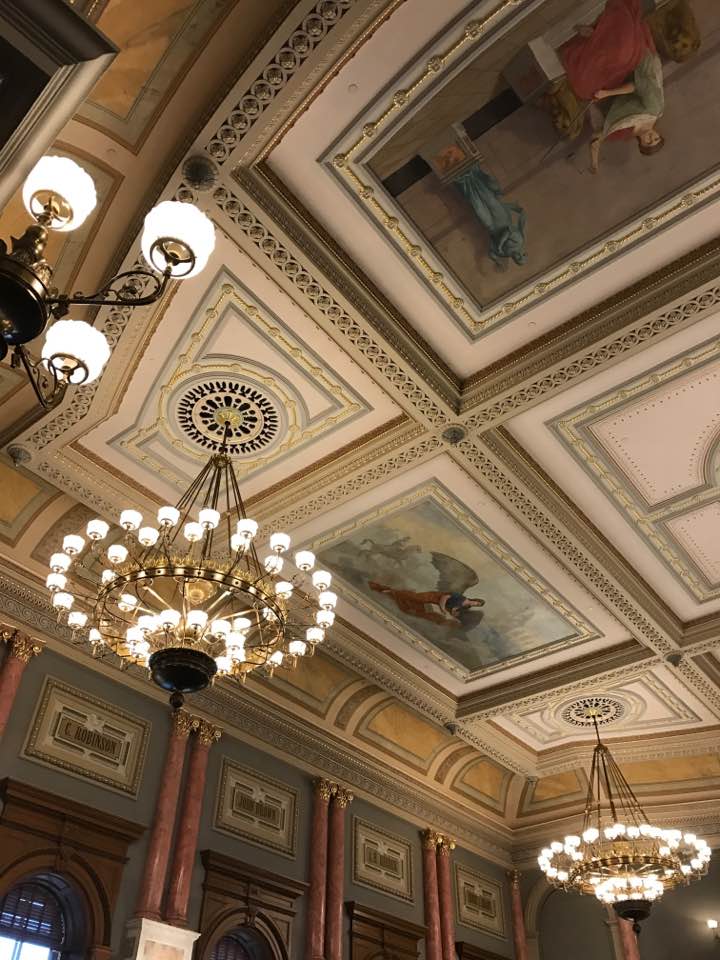
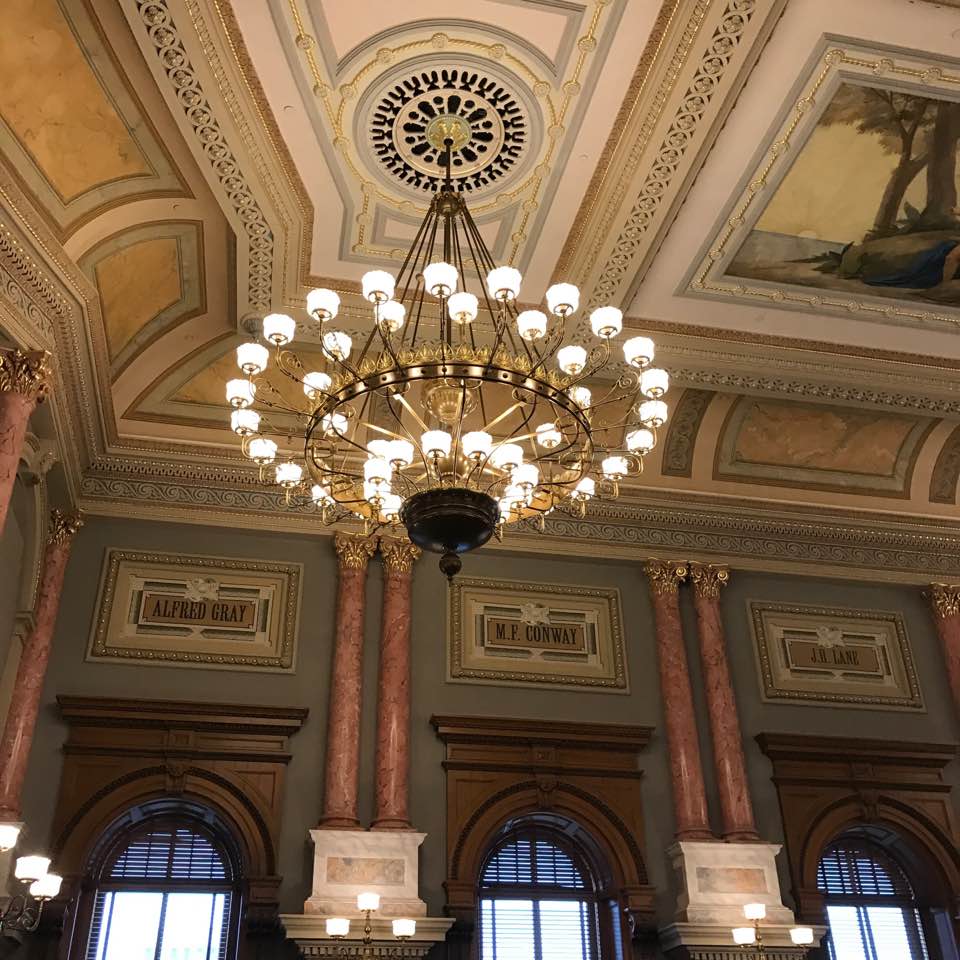
The House of Representatives Hall has to be my favorite room in the statehouse. Its exquisite architecture mixed with its delicate interior design makes for a must-see when you're planning your visit. From the patterned carpet to the ceiling murals, this truly is an artist's life work at display. Believe it or not, but the ceiling murals were actually painted over for many years and were re-discovered during the restoration process that started in 1999. I was astonished when I had heard this information from my tour guide and asked as to why the murals would have been painted over. He replied, "We assume that the murals were seen as erotic during certain time periods throughout history." Even he was amazed at how they could have removed the paint without harming the murals that laid underneath.
This room houses the 125 state legislators for the state of Kansas. The room resides in the east wing of the building which was the second wing that was completed in the construction of the Capitol (it was completed in the early 1880's). My favorite aspect of the room has to be the gold that is placed around the murals and in other areas on the ceiling. The gold is 22-karat gold leaf and is also placed around the ceiling columns that are located upstairs in the viewing deck. The lighting, architecture, murals, and the overall interior design of this room makes for my favorite room in the statehouse and I think it'll make its bid to be yours as well. Be sure to enjoy some photos below!

*Note: please note that the Kansas State Historical Society website states that the room resides in the West Wing of the building but the gallery signs state that it is the "East Gallery". 


For any further information regarding the House of Representatives Gallery please refer to the following link posted below:
House of Representatives Hall & Gallery (KSHS)

Please be sure to catch me again soon 
as the next post will cover the room 
just across the statehouse. 

Saturday, April 1, 2017

Post #7, Wall Paintings (1st Floor)

Hello, and thankyou again for joining me. Today, we are going to talk about some of the wonderful wall paintings that you will find on the 1st floor of the rotunda in the Kansas State Capitol Building. While all of these pieces are paintings, it’s important to notice that these paintings, in particular, were painted directly on the plaster walls of the Kansas Statehouse. That means there was no room for mistake; literally. All eight of these murals were completed in 1953 and they highlight important and significant events in Kansas history. The murals cover everything from small battles that occurred with native Indian tribes to the creation and implementation of the railroad system that forever changed how farmers would trade livestock and how people would travel.
At first glance, you become very aware that all the paintings were done with extreme care and detail, but what you probably didn’t notice is that each painting has a hidden object that the artist (David H. Overmyer) delicately placed. For example, you more than likely didn’t catch the rifle in the bottom left hand corner of the “Arrival of the Railroad” mural and that’s ok, because I didn’t either. In addition, some of the murals were painted using only three primary colors and I found this to be amazing when my tour guide told me this bit of exquisite information.
I encourage you to take a long and detailed look at all eight of the murals as it is likely that you will spot the hidden image if you do so. It is clearly obvious that Mr. Overmyer took his time in the creation of all eight of these beautiful decorated paintings and I guess he doesn’t have to worry about them going anywhere anytime soon! The names and photos of each mural are posted below, and I also encourage you to use the following links to gain a further understanding of just how special these paintings really are!

*Below you will find the corresponding plaques and paintings that are directly below one another.* 
(Links will be posted at the bottom of the page, after the photos).


For further information please refer to the following links:

Please make yourself aware that I consistently use the Kansas State Historical Society (KSHS) website
to gain an understanding of my topics which reside on this page. In addition, I would also like
to give thanks to my wonderful tour guide that provided me with further information that cannot be found 
on the KSHS website. 

Thank You, 

Please join me again soon as I delve into the 
House of Representatives conference room which is 
surprisingly an exhibit that visitors can visit as well.


Thursday, March 30, 2017

Post #6, The Famous Cage Elevator


You may be asking yourself “why have a blog post about an elevator?”. Well, this isn’t just any old elevator that you can ride. This is what is to be considered a cage elevator, in that it rides up and down an open shaft. Usually when you get on an elevator the shaft isn’t visible and is behind a casing of some sort. Now, there are plenty of these boring original elevators, four of them to be exact, located in the Southeast, Southwest, Northwest, and Northeast corners of the building that can take you from the Ground level to the 5th floor but you won’t want to ride on those, you already do that every day anyways. The cage elevator was built in 1923 and has remained in its original position ever since (located on the east side of the building). Although, in 1976, the Kansas state legislators were contemplating on removing the famous cage elevator and its shaft to supply more room for restoration and floor planning. Senate members quickly made a decision that was agreed upon by all; to keep the elevator. This decision had been concluded with the final explanation that the elevator’s historical significance to the building was too important to demolish it and the senate members ordered it to remain under extreme care and maintenance for passenger use. Since then, the elevator has been showcased in a couple of movies and has been the single most visited item within the statehouse. The cage elevator operates from the 1st floor (above ground level) to the 5th floor or what is simply known by as the rotunda floors, as the rotunda is visible from floors 1 to 5. If you visit today, you will notice that the elevator is always operated by a member of staff as well as the fact that it has been kept in its original condition.


Please note that some information was respectfully interpreted by members of staff and used in the completion of this blog post. In addition, I often use the Kansas State Historical Society to gain a basic view and concept of my topics in the creation of each individualized post. For further information regarding the cage elevator as well as other public elevators that are available to visitors please refer to the following links. 
Thank You,

Please be sure to join me again shortly as the next blog post I will be covering information about some of the beautiful canvas paintings and wall paintings that you will encounter as you make your way through the Kansas Statehouse. 

Sunday, March 12, 2017

Post #5, The Second-Floor Rotunda

This week, we will discuss some of the statues and canvas paintings that are located in the second-floor rotunda of the Kansas State Capitol Building. The Kansas Statehouse displays some of the most exquisite artwork found in all Capitol buildings in the United States. If you visit, you will find that most of the art pieces were actually constructed and created by Kansan's themselves. The following four individuals below are historical Kansan's who are remembered for their bravery and wit. Their actions have influenced the progression of the state as well as the United States as a country. Each statue is made out of solid limestone that weighs in at an average of two-thousand pounds each! It is astounding to consider that these statues were hand-crafted by Mr. Peter F. "Fritz" Felten, Jr. Although these statues are beautiful in all their glory, what is more interesting is that they are considered to be more like time capsules than anything, as all four statues contain important historical artifacts underneath the statue itself. These items are obviously not visible to the naked eye as they are physically behind the granite wall that is impossible to compromise with bare hands. The plaques underneath each statue clearly state the significance of each individual in addition to the time of when the capsules are to be opened. It is uncertain what is actually contained in these time capsules but it intrigues anyone who decides to pass by for a short visit. 

Amelia Earhart, a famous woman known for
aviation expertise set out for the Pacific Ocean
in 1937 and never returned. It is said that Amelia
ran out of fuel and crashed somewhere in the Pacific;
where however, no-one knows.
For further information regarding the conspiracy
of Amelia Earhart's whereabouts refer to the following link
(What Happened to Amelia Earhart?)
According to the plaque, the Amelia Earhart time capsule is
set to be opened on September 17th of 2087.


Dwight David Eisenhower, best known for being
the 34th President of the United States also served
in the U.S. military in World War II as a five star
commander and general. 
According the plaque above, Dwight D. Eisenhower's
time capsule isn't going to be opened until the year 2090.

William Allen White was a famous and notarized publisher
who was the recipient of the Pulitzer Prize on two occasions.
According to the following plaque, the time capsule for
 Mr. William White is dated to open in 2061, which will
 honor the two-hundredth anniversary of state progress.

Arthur Capper was the first native born governor
of the state of Kansas and hosted and owned
many radio stations and later served in the U.S. Senate.
Arthur Capper's bicentennial time capsule will be opened on
July 4th of 2076 which will honor the nation's two-hundredth
anniversary.
Panoramic view of the second-floor rotunda.
The gorgeous view of the inner dome from the
second-floor rotunda.

The following video highlights the breathtaking journey up the 296 steps that lead individuals into the outer dome. The Kansas State Capitol holds these tours Monday through Friday starting at 9:15 in the morning and continuing each hour until 3:15 in the afternoon (9:15, 10:15, 11:15, 12:15, 1:15, 2:15, & 3:15). Please visit the following link for further information regarding dome tours in the Kansas State Capitol Building! Dome Tours in the Kansas State Capitol Building


If you would like to know any further information about the four statues in the second-floor rotunda, then please visit the 

The following are links for the statues that were discussed earlier in this blog post!
Amelia Earhart (Amelia Earhart Statue)
Dwight David Eisenhower (Dwight D. Eisenhower Statue)
William Allen White (William A. White Statue)
Arthur Capper (Arthur Capper Statue)

Thank you for joining me for yet another wonderful week. 
Be sure to check back up soon for another informational blog post about our State Capitol Building.
*Fun Fact: Did you know that the Kansas State Capitol Building is taller than the U.S. Capitol Building in Washington D.C.

Saturday, March 4, 2017

Post #4, Exhibiting History and Art

If you don't know much about the State Capitol; it is considered to be the number one stop for architecture and art work in the state of Kansas. The building took on what was considered "an impossible task" in 2014, in that of a major renovation. The renovation added new murals, statues, and many other pieces of art work that is a part of The Kansas State Capitol Visitor Center is the entrance into the Capitol Building which is located on the North Side of the building. Once you enter, you will be greeted by the Capitols security and be given orders to pass through a metal detector (much like airport security). After passing through security, you will be introduced to one of the many exhibits that the Capitol has to offer to its visitors. 

This particular exhibit is located on the ground level of the Capitol and it displays many historical pieces. Everything from the thirty-four star U.S. flag to an original dome window that was placed on the outer dome in 1903. The exhibit covers everything from notable Kansan's, historical events in Kanas, and the Capitols history itself. This gorgeous exhibit is surrounded by offices that houses the many different departments of the Kansas State government and many, many skylight windows. When you enter from the north side of the building, you will first set your eyes on the part of the exhibit that displays notable Kansan's that have had an influence on the state of Kansas as well as national significance. During the 1800's, Kansas was known for birthing some of the brightest individuals of the time. People like John Brown, Fred Harvey, Amelia Earhart, James Naismith and Dwight D. Eisenhower have had national influence that progressed the history of Kansas. These individuals have created, designed, and implemented their life-changing and revolutionizing ideas into the world in which we all know today.

The most enjoyable part for me was seeing what seems to be "cell blocks"? Did individuals use to be held in the ground floor of the State Capitol? It wouldn't be surprising if this was the case, but it's hard to say. The building has seen major renovations over the years and it's hard to know for sure if this was the case. These "cell blocks" are located in the middle of the ground level floor and are in what seem to be a rectangular pattern. It's hard to know whether there were individuals who were placed here or not because if there was it most likely happened a century ago if not longer than that.  This is no doubt the conversation starter for tourists who happen to witness this setting as there is literally no further information that you can gain from the exhibit regrading this topic. It's truly interesting, were there prisoners kept here? If so, what happened here and were only the most dangerous individuals placed front and center?
*Check out the pictures below and tell me what you think in the poll located in the side bar and make sure to leave a comment below to share your thoughts and knowledge.

* (Unfortunately, I wasn't able to cover everything that this exhibit does, but I can tell you that it's a privilege to have the Capitol Building as the topic of this blog.) *


What do you think?


Thank You for joining me for yet another week and for another wonderful blog post about the Kansas State Capitol. Next week, we are going to talk about some of the canvas paintings and sculptures that you will encounter while making your way through the best architectural masterpiece in the state of Kansas.

*This blog post has a high influence from the Kansas Historical Society and therefore I will refer you to the following page which consists of further information regarding the Statehouses many interactive exhibits. (https://www.kshs.org/p/kansas-state-capitol-visitor-center-exhibits/18477#lobby)*

*Also note that some of the information provided in this blog is taken by individuals and tour guides who currently hold positions at the Kansas State Capitol as well as some information was reviewed from the official Kansas State Historical Society webpage.*


For your convenience, here is the address to the Kansas 
State Capitol Visitors Center.